Swimming Worm Bass Fishing
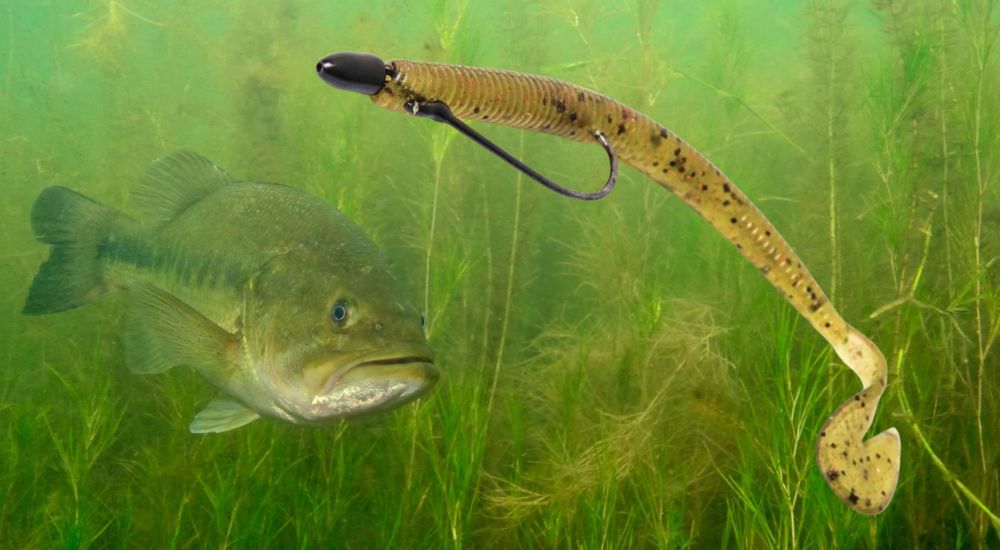
If you live down south, you are likely familiar with this technique, but for some reason, it doesn’t get as much recognition throughout the rest of the country.
But swimming a worm catch bass from Florida to Washington and is a technique that you need to add to your arsenal.
Swimming worm bass fishing might just be your next best bait that takes your fishing to the next level!
What is a Swimming Worm?
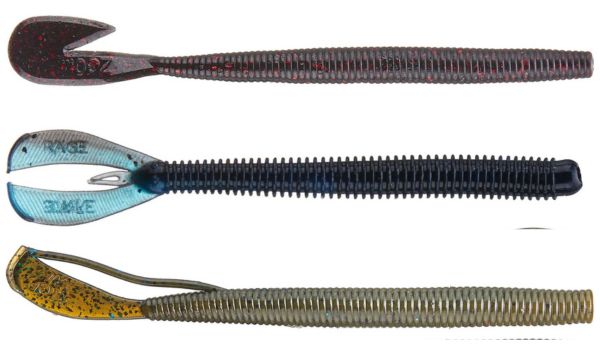
There are a few different designs depending on the exact company that makes the bait, but all swimming worms will have the same general design.
A swim worm is essentially just a stick bait (or Senko style worm) that has some type of swimming tail appendage on the end.
There are a variety of swim tails such as curl tails, speed tails, boot tails, and others. But they all do the same thing.
They add a bit of vibration and swimming action to the classic stick bait presentation. And let me tell you, they get bit!
How to Rig a Swim Worm
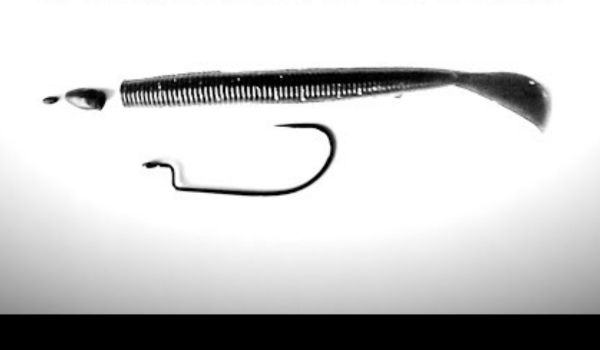
The rigging is incredibly simple and will be nothing new. All you do is Texas rig the worm like you would any other worm or creature bait.
The only difference is that you will use a bit lighter bullet weight than a standard Texas rig. I use a 1/8 oz bullet weight about 90% of the time.
Occasionally, I will go up to a 3/16 oz weight if there is a. bit of wind, but generally, 1/8 oz is the way to go.
And then the hook choice is really up to you. I personally like a 3-4/0 offset worm hook. Bit you you prefer an EWG or straight shank style hook, those work just fine as well.
And then lastly, you will want to use a peg or bobber stop to keep your bullet weight pegged up against your worm at all times.
This just keeps the worm and weight connected as one and makes swimming and casting it around much easier and more fluent.
Where to Fish a Swimming Worm
Grass is the name of the game when fishing a swimming worm. This is why it was initially popularized down south for Florida bass fishing where there is tons and tons of grass.
But a swimming worm excels nationwide as long as you have shallow water grass. The light weight and incredibly streamline profile of the swimming worm allows you to glide the bait through, over, and under all types of vegetation.
From lily pads, to hydrilla, to duck weeds, to milfoil, and even snot grass. A swimming worm is an incredibly finesse and enticing way to cover shallow water grass and catch tons of bass.
How to Retrieve It
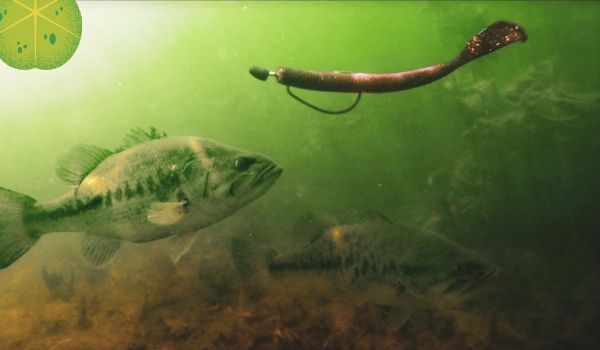
This is one of the biggest advantages of a swimming worm over other lures. There is literally NO wrong way to retrieve the bait.
Of course, hence the name, the primary retrieve will be a slow reel with occasional pops and pauses mixed in.
This actually makes the worm swim and bend through the water column just like a swimbait or swim jig.
But it gives the bass a worm profile which just seems to get so many bites, especially during the worm months.
But if you get a whole in the grass or some rocks, you can drop the worm all the way to the bottom and drag/hop the bait exactly like you would a standard Texas rig.
And then if grass is topped off or almost topped off, you can even keep your rod tip high and fish the worm all the way up on the surface, much like you would a buzzbait or buzz toad.
Because of the light bullet weight, the swimming worm will glide and flow through the water as it swims and looks incredibly natural and enticing.
Again, there is literally now wrong way to retrieve these swimming worms, just fish it as many ways as you can to best cover shallow water grass and you will get bit!
When to Fish a Swimming Worm
Because a swimming worm is made to fish shallow water grass, anytime of year that you have tons of shallow grass, it is a great time to fish a swimming worm.
But if you don’t live down south, this will primarily be during the summer months when the vegetation gets thick all across the country.
I live in Virginia, and I usually start heavily fishing a swimming worm during the post-spawn which is right around May to early June.
And then I will fish it all the way up until the vegetation starts dying off during the fall months.
But depending on where you live, just know that a swimming worm works great anytime there is shallow water grass.
Worm Profile in the Summer
For whatever reason, soft plastic worms simply get bit like crazy during the summer time.
I honestly can’t tell you the exact reasons or science behind this, but from my experience and from all the guys I’ve talked to over the years, worms simply catch more bass in the summer time.
Whether it is a shaky head, a wacky rig, a big ribbon tail, a ned rig, or any other type of worm fishing, it is almost impossible to beat the long, slender profile of a worm during the summer months.
So adding a swimming worm to your arsenal allows you to fish faster and cover more water while still giving the bass a worm profile that they simply can’t stop eating!
Something Different
The final reason that swimming worms are so good is that they show the bass something a little different.
When fishing shallow grass (especially during the summer), bass are constantly seeing the more popular techniques like a swim jig, chatterbait, frogs, and other very popular baits.
But far fewer guys are fishing a swimming worm. So it shows the bass something a bit different that they haven’t become conditioned to avoid.
Giving you an advantage over all the other guys fishing the exact same places as you.
Use Fluorocarbon
I always fish my swim worms on fluorocarbon line. The reason is that when there is tons of vegetation and grass, it is almost always clear water.
(Muddy water won’t allow enough sun in the water and will kill off the plant life under water).
So when fishing the subtle, enticing swim worms in clear water, the visual profile is crucial. And a very visible braided line takes away from the profile and makes your worm look a bit worse.
It isn’t necessarily a deal breaker, but I personally have much more confidence with fluorocarbon line and feel like it gets me more bites.
Also Read: The 3 Best Swimming Worms
Reeling this In
A swimming worm is an incredibly versatile and effective tool to have in your tackle box. Its unique blend of a classic worm profile with the action of a swimbait makes it a lure that bass simply can’t resist.
Don’t wait any longer; add this powerful technique to your fishing arsenal and start reeling in more fish!