Best Line for Swim Jig Fishing
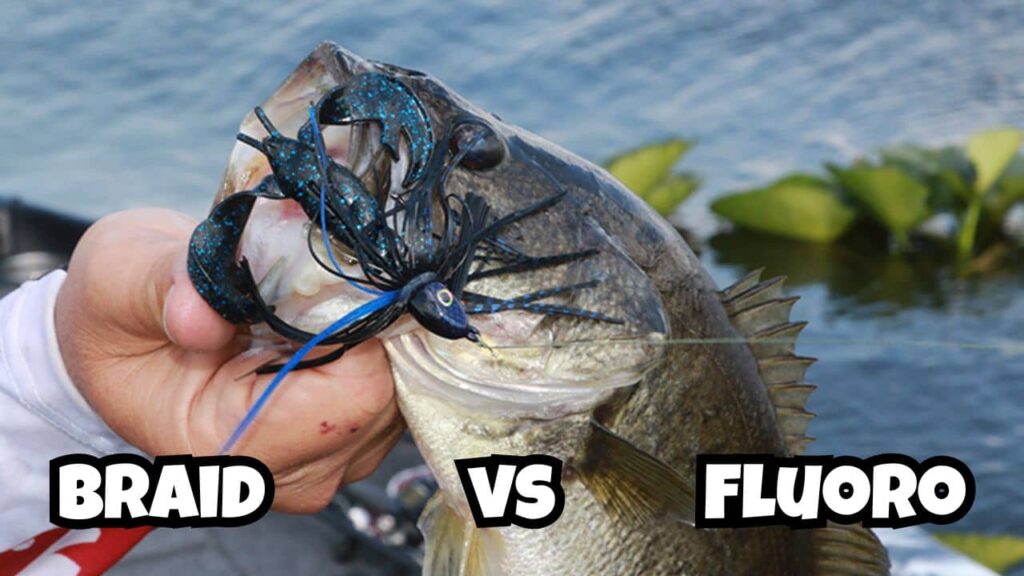
Swim jig fishing is one of the most fun and effective techniques for fishing shallow water cover. And one of the most common questions surrounding the swim jig is what line you should use when fishing it.
There are a couple of different things to consider and situations the keep in mind. So really quickly, let me go over the best line for swim jig fishing depending on the exact fishing conditions.
Fishing Primarily in Vegetation: Braided Line
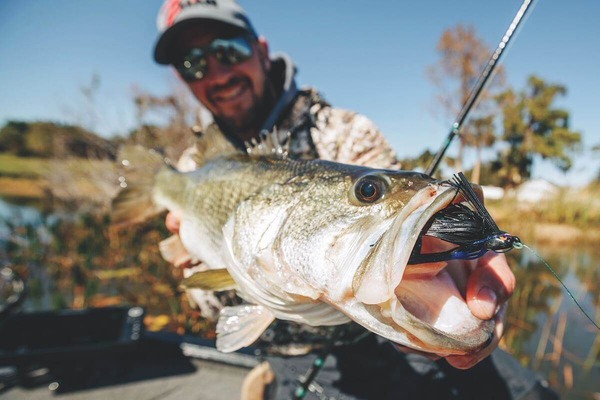
The swim jig is designed to be fished in shallow water cover. And vegetation such as lily pads, hydrilla, milfoil, snot grass, and whatever other vegetation dominates your shallow waters are a huge part of shallow water cover fishing.
If you are primarily fishing your swim jig through and around soft, vegetation based cover, braided line will be the better option.
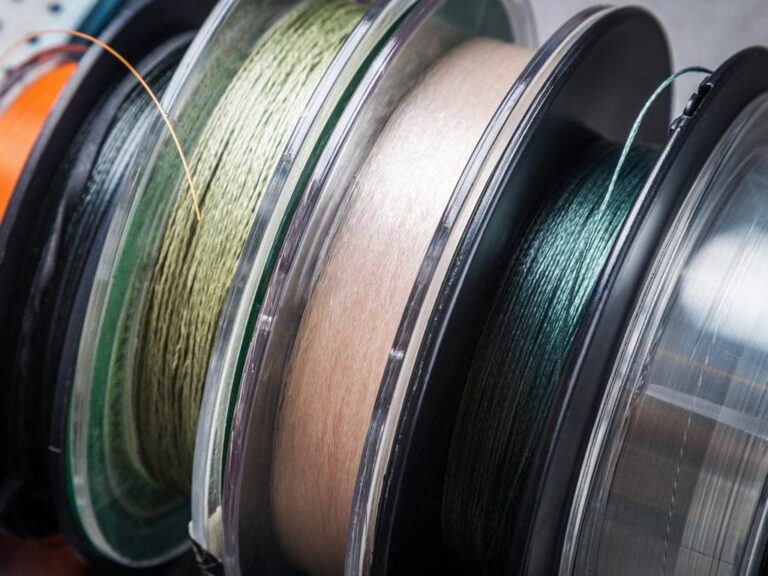
There are two reasons why braid is the best line choice for soft cover. First, braided line is much thinner as well as rougher than nylon based lines.
And because of the thin diameter and rough texture, braided line is able to cut through vegetation quite well, allowing you to fight and land fish much easier without having to drag too much green stuff along with your.
Second, braided line can be used in very high pound tests, all the way up to 50-65 lb tests. This way, if you do end up hooking into a bass and it dives into some grass or balls itself up in a ton of snot grass, you still have enough line strength to drag the bass back to you without risking your line snapping.
A nylon line might only be 15-20 lb test, and could very likely snap if you needed to drag a bass in through a bunch of vegetation. So if you are mostly fishing soft, vegetation, use braided line.
Fishing Primarily Wood/Brush: Fluorocarbon Line
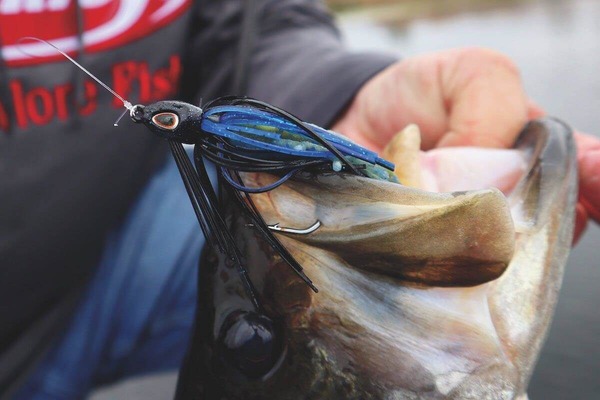
If you are primarily fishing hard cover like wood, docks, or brush piles, fluorocarbon line will be the better line option for swim jig fishing.
Again, there are really two reasons why fluoro works better in hard cover. First, fluorocarbon is much more abrasion resistant than braided line.
So although braid can come in higher pound tests, fluorocarbon is actually much more durable when it comes to getting scratched, nicked, or cut.
And hard structure like branches or docks can easily rub against your line and scratch or nick the line.
So abrasion resistance is more important than horse power when fishing hard structures. Second, fluorocarbon line is much harder to see underwater, which will always get you more bites if the bass can’t see your line.
When fishing grass or vegetation, visibility doesn’t matter as much because a dark green braided line will actually blend in very well with the stringy, green grass or vegetation.
But when contrasted against hard cover like wood or dock limbs, braided line is much easier for the bass to see.
So because abrasion resistance and line visibility are much more important around hard cover, fluorocarbon is the better line for swim jig fishing in these situations.
Overall Better Line Option
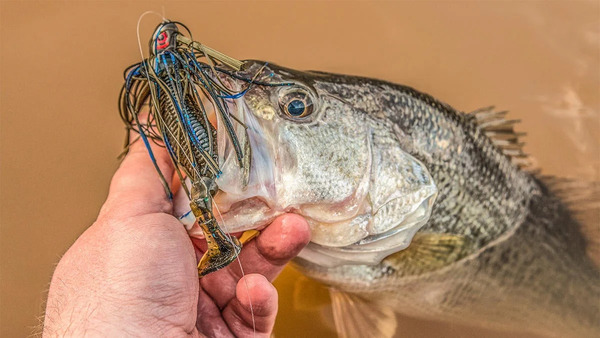
There are two ways that I look at this. For me, I believe that braid is the overall better line option for swim jig fishing.
I personally fish more vegetation than wood with a swim jig, so when it comes to structure type, I find braid is the better option most of the time.
Additionally, braided line is much thinner and lighter weight, which gives you a better, more direct connection to the swim jig.
I like this because it helps me control the bait a bit better and give it the exact action I want.
On the other hand, if you are someone who wants to use a swim jig as an all purpose lure, and in all types of cover as well as out in open water, I would recommend fluorocarbon as the best overall line type.
There are a lot of fishermen who just fish the swim jig like it is a swimbait, casting and retrieving in open water.
And in that scenario, the lower line visibility is by far the most important characteristic of either line type.
So if you are like me, and are mostly fishing shallow water vegetation with a little wood and brush mixed in, then braided line will be the best overall line type.
But if you want to fish the swim jig like a swimbait, casting it in open water as well as shallow cover, then fluorocarbon line will be better.
Also Read: Best Swim Jig Weight
Reeling this In
Choosing the right line for your swim jig doesn’t have to be complicated. If you are targeting bass buried in heavy vegetation, reach for braided line to cut through the grass and provide the “horsepower” needed to haul fish out.
However, if you are skipping under docks or dragging through brush, the abrasion resistance and invisibility of fluorocarbon will serve you better.
Ultimately, let the environment dictate your setup. Match your line to the cover you’re fishing most often, and you’ll find yourself landing more fish and losing fewer lures.